Digital Torque Wrench vs. Mechanical Torque Wrench: Which Is Better for Precision Work? | PT Panca Makmur Baru
In fields ranging from automotive work, maintenance, and engineering to manufacturing and construction, there is a factor that often appears simple yet is crucial to the quality of the work: the amount of torque applied to a fastener.
Many people still rely on “feel”:
- “It’s tight enough.”
- “That seems sufficient.”
- “The bolt has bottomed out.”
However, a fastener does not always require maximum tightening. What is actually needed is a torque value that aligns with the specific requirements of the joint.
Insufficient torque can result in inadequate clamping force, while excessive torque can overload the fastener or the component itself. This principle makes torque control a vital aspect of professional fastening work.
For this reason, a torque wrench is far more than just a tool for tightening bolts.
It is an instrument designed to control the tightening process, ensuring consistency and precision.
And when you start looking for a torque wrench, the next question arises:
Is it better to use a digital torque wrench or a mechanical (micrometer-style) torque wrench?
The answer isn’t as simple as saying “digital is more modern.”
Both types offer their own distinct advantages.
Torque Wrench
Before comparing the two, we need to understand their basic functions.
Torque is the twisting force applied to an object. In fastening operations, torque serves as a practical method for controlling the tightening force applied to a fastener and achieving the clamping force required for the joint.
Commonly used torque units include:
- N·m (Newton-meter)
- ft-lb (foot-pound)
- in-lb (inch-pound)
- kg-cm / kg-m
Since every application has different torque requirements, selecting a torque wrench based solely on drive size is insufficient.
You also need to consider:
Torque range → drive size → accuracy level → mechanism → reading method → job requirements.
This is what distinguishes a professional torque wrench from an ordinary wrench.
Why Is Torque Control Important?
Imagine that a bolt on a machine component requires a certain torque.
If the torque is too small, the connection may not get the necessary clamping force.
If the torque is too large, the fastener and the components being tightened can receive an inappropriate load.
In engineering applications, fastening consistency becomes increasingly important when there are many fasteners with the same specifications.
For example, in the assembly process.
If technician A tightens the bolts with a different feeling than technician B, the final results may be different even though they use the same type of bolt.
With a torque wrench, this process can be made more controlled.
This is the reason why torque wrenches are widely used in automotive repair, equipment maintenance, machinery assembly, manufacturing and other engineering work.
Digital vs. Mechanical Torque Wrench: What’s the Difference?
| Aspect | Digital Torque Wrench | Mechanical/Micrometer Torque Wrench |
| How to read | LCD display | Mechanical scale |
| Arrangement | Digital | Manual/micrometer |
| Feedback | LED + buzzer | Click mechanism |
| Use | Quickly read the torque value. | Manual torque adjustment |
| Ease of monitoring | Very easy | Requires a scale reading |
| Battery requirements | Yes | No |
| Suitable for | Tasks requiring visual or audio feedback | Pekerjaan fastening profesional yang membutuhkan mekanisme sederhana dan robust |
| Calibration certificate | Available on the KENNEDY series. | Tersedia pada seri KENNEDY |
However, this table only outlines the differences in general terms.
What is interesting is seeing how those differences manifest when a torque wrench is actually used in the field.
Digital Torque Wrench: When Clear Feedback Is Needed
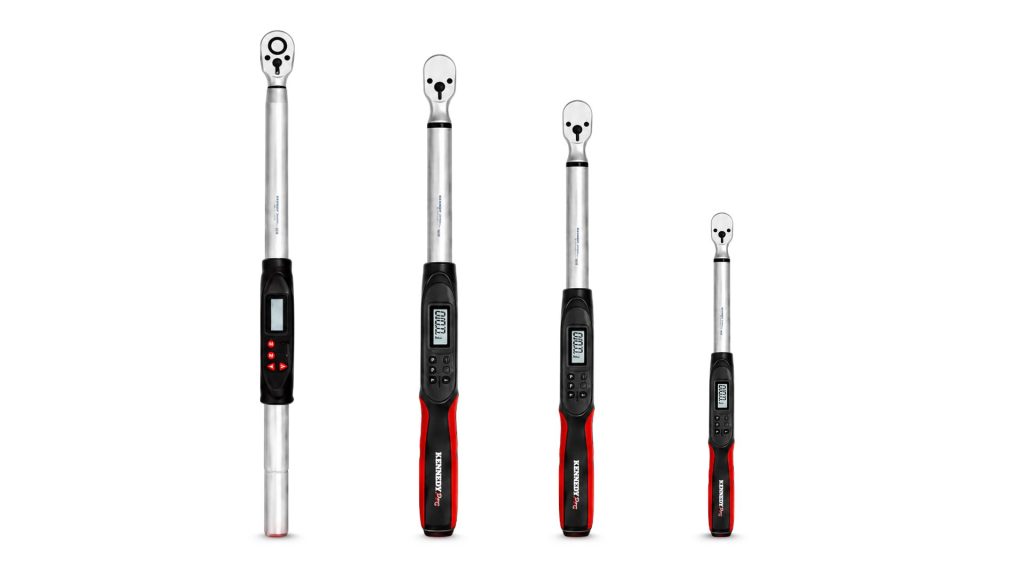
A digital torque wrench offers one immediately noticeable advantage:
torque information can be viewed directly on the display.
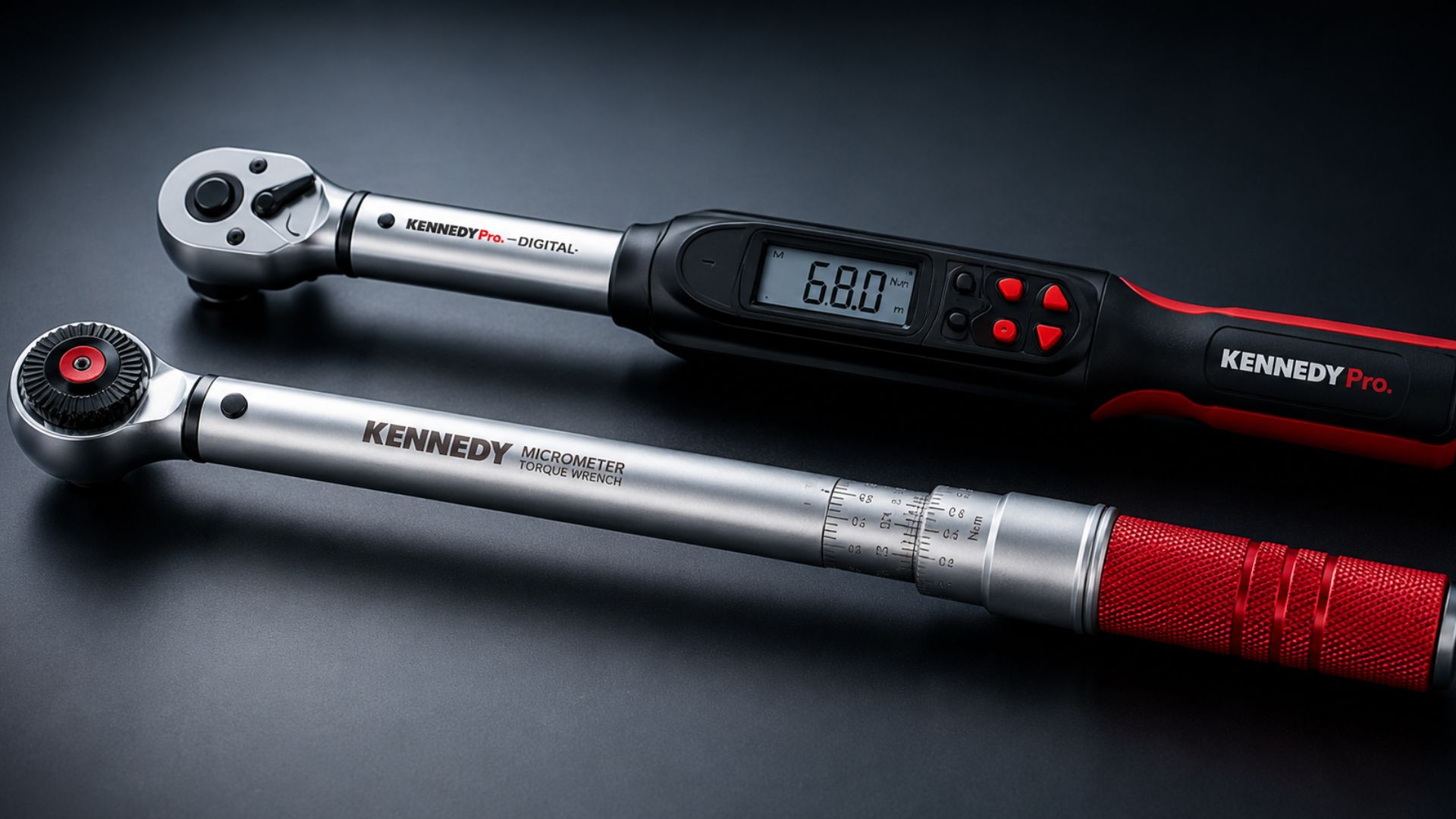
On the KENNEDY Pro Digital Torque Wrench, the LCD displays torque values in several units:
- N·m
- ft-lb
- in-lb
- kg-cm
In addition to the display, KENNEDY utilizes a Smart LED Alert system.
A green light illuminates when the torque reaches approximately 90% of the target, followed by a red light when the target torque is achieved.
An audible buzzer also provides sound confirmation.
This means technicians do not need to constantly monitor a mechanical scale.
When approaching the target:
The LED provides a warning.
When the target is reached:
The LED and buzzer provide confirmation.
Features like this are helpful when technicians are working with torque procedures that require consistent adherence.
KENNEDY Digital Torque Wrench: Not Just for One Type of Job
One of the advantages of the KENNEDY Digital Torque Wrench series is the fairly wide torque range choice.
| Drive Size | Torque Range | Teeth |
| 1/4″ | 1.5–30 N·m | 72T |
| 3/8″ | 6.8–135 N·m | 72T |
| 1/2″ | 17–340 N·m | 72T |
| 3/4″ | 42.5–850 N·m | 48T |
This distinction is important. Choosing a torque wrench isn’t just about saying:
“I want a digital one.”
It is about asking:
“What torque level do I need?”
For instance, if the job requires torque in the range of tens of N·m, you don’t need to jump straight to a model with a range extending into the hundreds of N·m.
Conversely, machinery work or industrial fastening applications requiring high torque demand a tool with the appropriate drive size and torque range.
What about Mechanical or Micrometer Torque Wrench?
A mechanical torque wrench employs a manual torque adjustment mechanism.
With the KENNEDY Micrometer Torque Wrench, the user sets the torque using a micrometer-style design featuring a locking system to help maintain the selected setting.
The desired torque is achieved through the wrench’s mechanical mechanism.
- No LCD screen.
- No batteries.
- No digital menus.
In fact, this simplicity is one of its key advantages.
For technicians accustomed to reading torque wrench scales who desire a straightforward tool, a mechanical torque wrench can be a highly practical choice.
KENNEDY Micrometer Torque Wrench: Simple, Yet Professional

The KENNEDY Micrometer Torque Wrench features:
Chrome Vanadium construction for the ratchet head, a knurled grip, a quick release button, and a 72-tooth reversible mechanism. The product also comes with a calibration certificate.
It offers a wide range of torque specifications:
| Drive Size | Torque Range |
| 1/4″ | 1–6 N·m |
| 1/4″ | 5–25 N·m |
| 3/8″ | 10–60 N·m |
| 3/8″ | 20–100 N·m |
| 1/2″ | 40–200 N·m |
| 1/2″ | 60–340 N·m |
| 3/4″ | 150–800 N·m |
With these options, users can select a torque wrench based on their specific application requirements rather than simply relying on the tool’s physical size.
So, is digital more accurate than mechanical?
This is a fairly common misconception.
“Digital” does not automatically mean “more accurate.”
Conversely, a mechanical tool is not necessarily less precise simply because it lacks a digital display.
What matters are the product’s accuracy specifications, testing methods, applicable standards, and the tool’s condition and calibration status.
The KENNEDY Digital Torque Wrench specifies ±2% accuracy for clockwise measurements and complies with ISO 6789:2017; it also comes with a calibration certificate.
Meanwhile, the KENNEDY Micrometer Torque Wrench the reference model in this series lists a ±3% tolerance, complies with ISO 6789, and also includes a calibration certificate.
So, when choosing a torque wrench, do not simply look at whether it is digital or manual.
Check the technical specifications.
The Importance of ISO 6789:2017
If you work in the industrial sector, the term ISO 6789 is likely familiar to you.
ISO 6789 is an international standard concerning hand torque tools, covering requirements and methods for design conformance, quality conformance, as well as calibration and the determination of measurement uncertainty.
Why is this important?
Because a torque wrench is a measuring instrument.
If a torque wrench indicates a value of 100 N·m, the user needs assurance that this value has a known and verifiable level of deviation.
That is why a calibration certificate is not merely an extra piece of paper inside the box.
The document relates to the user’s ability to understand the measurement status of the tool being used.
Calibration Certificate: Do Not Take It Lightly
For tasks requiring torque control, simply owning a torque wrench is not necessarily enough.
You also need to consider the following:
- Does the tool have calibration documentation?
- When was it last calibrated?
- Has the tool ever been dropped or used for purposes other than those intended?
- Is the mechanism still functioning correctly?
KENNEDY provides calibration certificates for the Digital Torque Wrench and Micrometer Torque Wrench series discussed in this article.
Furthermore, torque wrenches require proper maintenance and usage. KENNEDY’s documentation recommends storing the tool in a safe, dry environment and reducing the torque setting after use. The documentation also recommends annual calibration.
For safety critical applications or heavy duty use, verification or calibration intervals should be determined based on company procedures, frequency of use, environmental conditions, and applicable quality requirements.
Don’t Choose the Wrong Torque Range
This may actually be more important than choosing between a digital or mechanical model.
For instance, suppose you need a torque of around 80 N·m.
A torque wrench with a 1–6 N·m range would clearly be unsuitable.
Similarly, if the requirement is only 15 N·m, choosing a tool with a vastly different range might not be the best choice.
Ideally, determine the following first:
What is the fastener’s torque specification?
Then, select a torque wrench that covers that value with an appropriate range. Therefore, before purchasing a torque wrench, it is best to have the following information ready:
- Torque specification
- Fastener size
- Drive size
- Torque unit
- Type of application
- Frequency of use
- Documentation or calibration requirements
Don’t Get Caught Up in “72 Teeth”
Since we previously discussed tooth count, there is one point that needs clarification.
A 72-tooth (72T) specification does not automatically mean a torque wrench is stronger than a 48 tooth (48T) model.
The tooth count primarily relates to the ratchet mechanism and the minimum swing arc required for the next engagement.
Regarding KENNEDY Digital Torque Wrenches:
The 1/4″, 3/8″, and 1/2″ models feature a 72T mechanism.
In contrast:
The 3/4″ model features a 48T mechanism.
Why?
Because the 3/4″ model is designed for a much higher torque range specifically 42.5–850 N·m.
This demonstrates that selecting a torque wrench cannot be based solely on the tooth count.
Torque capacity, drive size, mechanism, construction, and application requirements must all be considered together.
Digital or Mechanical? Choose Based on How You Work
Now we come to the key question.
Choose the KENNEDY Digital Torque Wrench if you require:
- LCD torque readout
- LED indicator
- Audible buzzer
- Immediate feedback when approaching the target
- Clockwise and anti-clockwise operation
- Multiple torque unit options
- Torque range up to 850 N·m
- Calibration certificate documentation
The KENNEDY Digital Torque Wrench offers a range of 1.5 to 850 N·m, depending on the model and drive size.
Choose the KENNEDY Micrometer Torque Wrench if you require:
- Mechanical torque setting
- Micrometer system
- Locking mechanism
- 72T reversible mechanism
- Quick release
- Knurled grip
- Chrome Vanadium ratchet head
- No battery dependency
- Various torque range options up to 800 N·m
These specifications are available in the KENNEDY Micrometer Torque Wrench range.
Digital vs. Mechanical: Which Is More Suitable?
To put it simply:
For technicians who prioritize visual cues and feedback:
Digital Torque Wrench.
You can view the torque value in real-time and receive LED and buzzer alerts when approaching or reaching the target.
For technicians who prioritize simple mechanisms and practical use:
Micrometer Torque Wrench.
Settings are adjusted manually using a micrometer scale and a locking mechanism.
For companies with quality control requirements:
Either option is suitable, provided that the torque range, accuracy, calibration, and operating procedures align with the job requirements.
Do Not Use a Torque Wrench for Every Job
There is one habit that should be avoided.
A torque wrench is not a substitute for a standard ratchet for every task.
When removing bolts, for instance, use tools specifically designed for that purpose.
Torque wrenches are primarily used when you need to control the tightening torque.
By following the proper workflow, a technician can use a standard ratchet or socket for the removal and installation process, and then use the torque wrench for the final tightening stage according to specifications.
This approach prevents overuse of the torque wrench and helps preserve the tool’s measurement accuracy.
KENNEDY Torque Wrench for Automotive to Industrial Maintenance Applications
The need for torque control arises in various fields.
- Automotive
Used for tasks requiring manufacturer specified torque settings such as work on engine components, chassis, wheel assemblies, and various other fasteners in accordance with service procedures.
- Machinery Maintenance
Used to ensure that equipment fasteners are tightened according to maintenance specifications.
- Manufacturing
Torque control helps maintain assembly process consistency when producing large numbers of units to uniform tightening standards.
- Engineering
Torque wrenches are integral to the installation, maintenance, and repair of equipment subject to specific torque requirements.
- Workshops
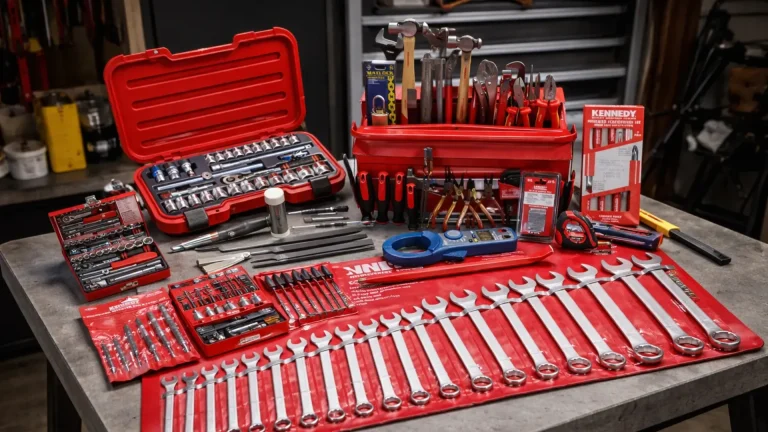
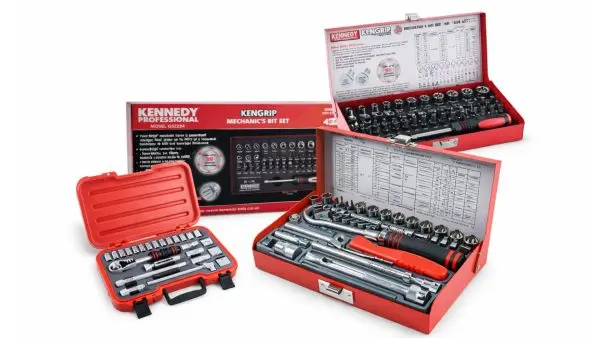
In professional workshops, combining socket sets, ratchets, and torque wrenches creates a more comprehensive fastening workflow.
KENNEDY Digital and Micrometer Torque Wrench, Which is Your Choice?
Ultimately, no single type of torque wrench is superior for every situation.
Digital torque wrenches excel when you require:
a display, feedback, and torque monitoring.
Micrometer torque wrenches excel when you prefer:
a mechanical mechanism, manual adjustment, and straightforward operation.
The most important step is to choose based on the torque range and application, then consider features, accuracy, drive size, the ratchet mechanism, and calibration requirements.
That is why KENNEDY offers more than one approach.
Not to confuse the user,
but to ensure the tools can be selected based on actual job requirements.
Looking for a KENNEDY Torque Wrench for industrial and workshop needs?
If you are looking for a KENNEDY Digital Torque Wrench or Micrometer Torque Wrench, PT Panca Makmur Baru offers KENNEDY tool solutions for automotive, engineering, workshop, maintenance, and industrial applications.
Not sure which drive size or torque range to choose?
Don’t just send an inquiry asking:
“Do you have KENNEDY torque wrenches?”
Instead, have the following details ready:
Required torque + fastener size + type of work + drive size used.
Providing this information ensures a much more accurate tool selection.
Need a KENNEDY Digital Torque Wrench or Micrometer Torque Wrench? Contact PT Panca Makmur Baru to get the KENNEDY products that best suit your job requirements.
Want to know more or place an order? Contact us at PT Panca Makmur Baru—the official Cromwell distributor in Indonesia. Click the “Contact Us” button now!