Oil Spill Mixed with Water? Get to know SABER Oil Absorbent Pads, Pillows & Booms that Absorb Oil Without Absorbing Water | PT Panca Makmur Baru
Spills of oil, grease, and diesel in industrial areas are more than just a housekeeping issue. Fluids leaking from production machinery, fuel tanks, or hydraulic systems can make floors slippery, disrupt operations, and even contaminate waterways if not addressed immediately.
The question is, what happens when oil mixes with water? Is it necessary to absorb everything water included?
Not necessarily.
For such situations, there is a specialized solution: SABER Oil Absorbent by Tandoox. This material is designed to capture hydrocarbon based liquids such as oil, diesel, and industrial lubricants while repelling water.
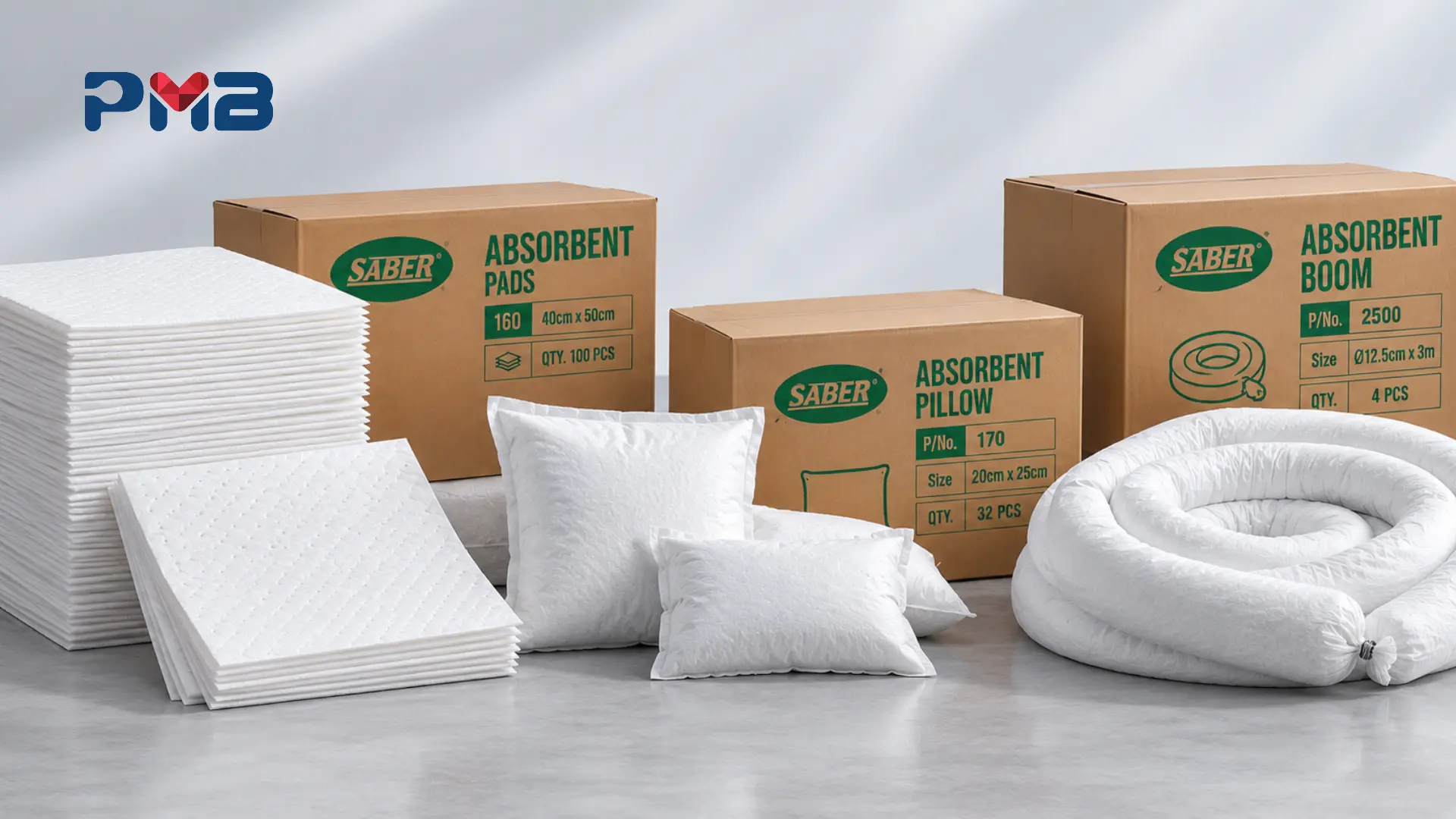
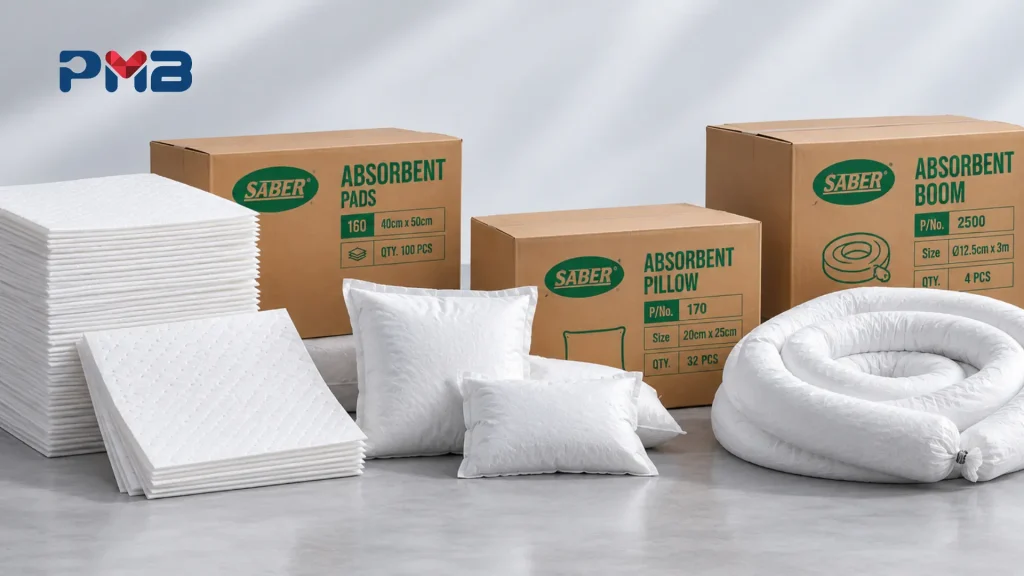
SABER comes in three forms, which can be selected based on the nature of the spill: Oil Absorbent Pads, Pillows, and Booms.
Why Should Oil Spills Not Be Taken Lightly?
Imagine a production machine experiencing a hydraulic oil leak while in operation. Initially, the oil might only drip slightly beneath the machine. However, if left unaddressed, the fluid could spread across the workspace, be tracked around by workers, or flow into drainage systems.
Such a situation can lead to several issues:
- Slip hazards: Floors contaminated with oil become slippery, posing a danger to workers.
- Operational disruptions: Production areas may need to be temporarily cordoned off for cleanup.
- Potential contamination: Oil or fuel entering the drainage system could reach water treatment facilities or the surrounding environment.
- Additional cleanup costs: Spills that spread over a larger area require more time, labor, and cleaning materials.
Prompt spill control is a vital component of good housekeeping, workplace safety, and industrial environmental management.
Therefore, the choice of absorbent material should be tailored to the specific type of liquid and the conditions of the affected area.
SABER Oil Absorbent
SABER Oil Absorbent is an absorbent product developed to help manage spills of oil and hydrocarbon based liquids in industrial environments.
Unlike standard cleaning cloths, this product is specifically designed to absorb and retain spilled liquids, making them easier to collect and remove from the workspace.
Its primary advantages stem from two material characteristics:
- Oleophilic — Attracts Oil
The material has an affinity for oil, allowing it to absorb or bind oil based liquids upon contact. - Hydrophobic — Repels Water
The material is designed to repel water, enabling its use in situations where oil is present on the water’s surface.
With this combination of properties, the Oil Absorbent is well suited for addressing oil slicks on water surfaces, managing spills in drainage areas, or cleaning up wet industrial floors.
Simply put, SABER Oil Absorbent helps capture oil without absorbing the surrounding water.
Although the material repels water, its ability to separate oil from water is still influenced by the specific type of liquid, the conditions of the spill, and the inherent properties of the material. This product is not a water purification tool, nor is it a substitute for a waste treatment system.
How Does Oil Absorbent Absorb Oil but Not Water?
Oil and water possess different chemical properties a distinction that “oil only” absorbent materials leverage.
Because these materials are hydrophobic (water repellent) and oleophilic (oil attracting), oil wets and interacts with the absorbent surface much more readily than water does.
When such an absorbent comes into contact with an oil layer floating on water, it captures the oil while repelling the water. For instance, this is effective when an oil slick forms on the surface of an industrial containment pond.
Oil absorbents can be placed directly onto contaminated surfaces to soak up the oil. Once saturated, the material can be retrieved and collected for further handling or disposal.
This principle makes oil only absorbents highly useful for industries that may encounter oil spills in either dry or wet environments.
It should be noted, however, that oil that has become emulsified with water or is otherwise finely dispersed may require additional treatment methods.
Getting to Know 3 SABER Oil Absorbent Products: Pads, Pillows, and Booms
Although they share a similar basic function, the three forms of SABER Oil Absorbent are designed for different handling requirements.
1. SABER Oil Absorbent Pads — Practical for Surface Spills
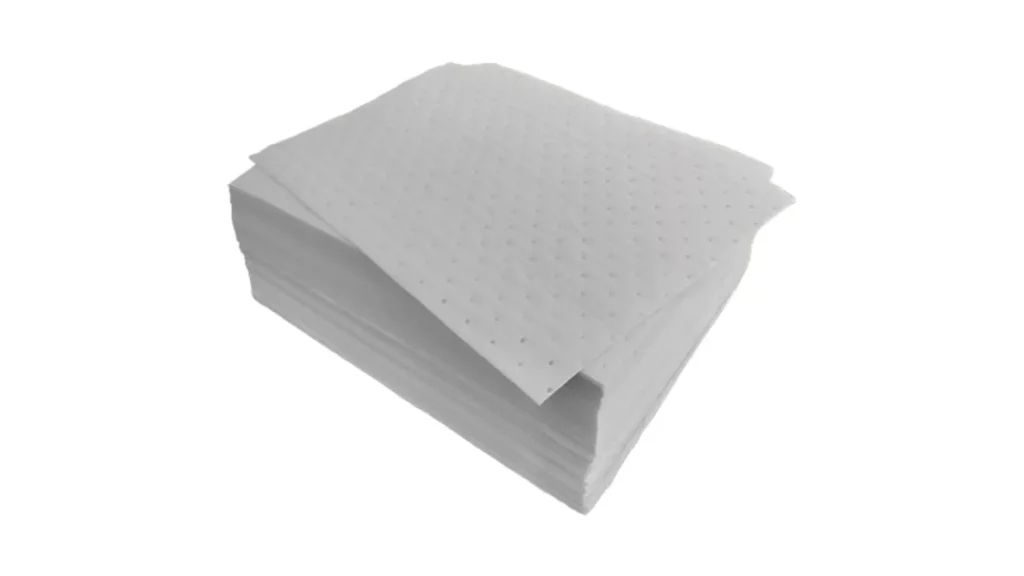
Oil Absorbent Pads are sheet like absorbent materials that can be placed directly onto spilled liquids.
Their flat design makes them easy to use on floors, beneath machine components, in maintenance areas, and at any spill site that is easily accessible.
SABER Oil Absorbent Pads are suitable for:
- Oil drips during maintenance activities.
- Hydraulic oil spills around production machinery.
- Residual oil during lubricant changes.
- Oil films on water surfaces.
- Cleaning up small to medium sized spills.
SABER also offers a “Pad 200” variant featuring perforations, allowing the sheets to be separated as needed for more targeted use.
When should you choose Pads?
Opt for Oil Absorbent Pads when a spill has already occurred on a surface and the primary objective is to absorb and remove the liquid in a practical manner.
2. SABER Oil Absorbent Pillows — Absorbing Pools in Hard-to-Reach Areas
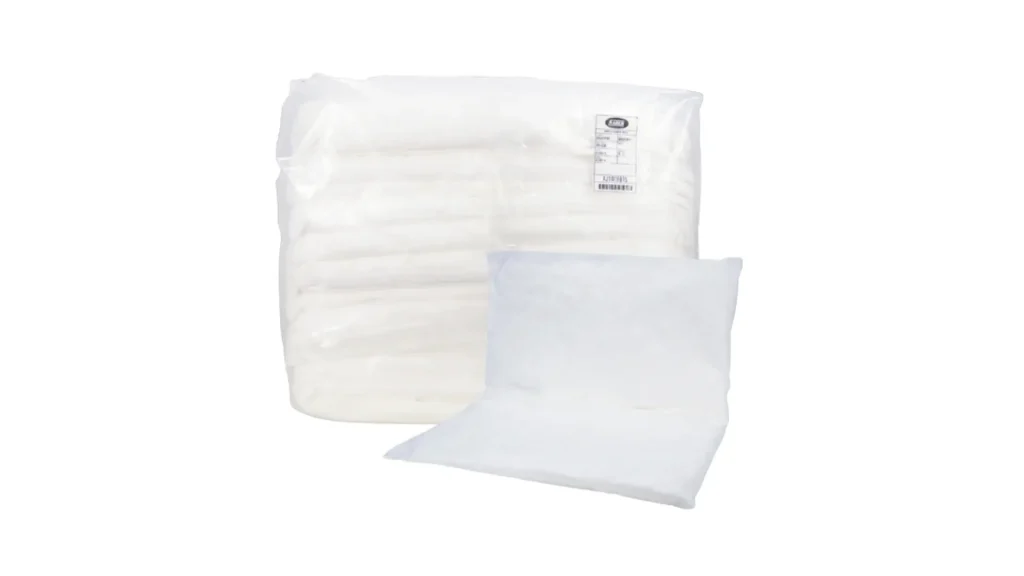
Unlike absorbent pads, oil absorbent pillows are designed as three dimensional cushions. Their shape allows them to be placed precisely where oil tends to accumulate.
Examples include locations beneath pipe joints, near hydraulic pumps, around machine mounts, or within confined spaces that are difficult to clean using flat sheets.
SABER Oil Absorbent Pillows can be used for:
- Managing oil that has pooled in a specific spot.
- Absorbing recurring drips from leaking equipment.
- Helping to contain oil near drainage inlets.
- Reaching underneath machinery or industrial installations.
- Handling spills in workshops and heavy equipment service areas.
When should you choose pillows?
Opt for oil absorbent pillows when a spill is concentrated in a single spot particularly in recessed areas or locations that require a thicker, more substantial absorbent medium.
For drainage systems, these pillows can help absorb oil around the inlet, but they should not be considered a liquid tight drain cover.
3. SABER Oil Absorbent Booms — Containing the Spread of Oil
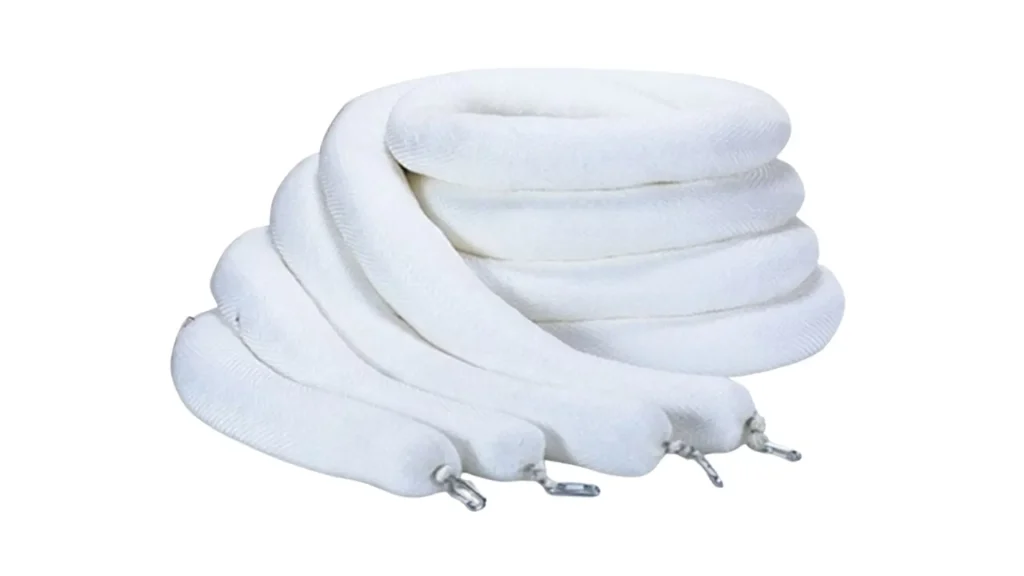
Oil Absorbent Booms are long, tube or bolster shaped products designed to help contain and absorb oil spills.
While absorbent pads focus on soaking up liquids on a surface, booms help limit the spread of a spill, making it easier to manage.
These products can be placed around a spill area, positioned along paths where oil might travel, or deployed on water surfaces, depending on site conditions.
SABER Oil Absorbent Booms are suitable for:
- Containing oil spills around industrial equipment.
- Managing oil spreading within workshop areas.
- Assisting with spill control near drainage systems.
- Capturing oil on relatively calm water surfaces.
- Handling spills in fuel storage or distribution areas.
When should you choose booms?
Opt for Oil Absorbent Booms when the primary priority is to contain the spread of oil before proceeding with absorption and cleanup.
For spills in bodies of water with strong currents, waves, or large volumes, further evaluation is required; in such cases, the use of containment booms and more specialized oil recovery equipment may be necessary.
Comparison of SABER Oil Absorbent Pads, Pillows, and Booms
| Types of products | Form | Main function | Application example |
| Oil Absorbent Pads | Sheets | Absorbs oil from the surface | Workshop floor, machinery, water surface |
| Oil Absorbent Pillows | Pads | Absorbs accumulated oil | Under the engine, in the recesses, around the pipes |
| Oil Absorbent Booms | Long tubes | Contain and absorb spills | Around spills, drainage, water surfaces |
Tip: For a more comprehensive approach, pads, pillows, and booms can be used together as needed.
Booms are positioned to help contain the spread, pillows are used at points where oil accumulates, and pads help absorb any remaining oil on the surface.
What Is the Absorption Capacity of SABER Oil Absorbent?
According to official product information for SABER Tandoox, various Oil Absorbent Pads, Pillows, and Booms have an absorption capacity stated to be approximately 9–11 times their own dry weight.
In theory, this means that a material with a dry weight of 1 kg can absorb approximately 9–11 kg of liquid under appropriate testing conditions.
However, these figures should not be taken as a guaranteed capacity for all scenarios. Absorption performance can be influenced by factors such as:
- The viscosity (thickness) of the oil.
- The specific type of oil or fuel.
- Temperature and environmental conditions.
- The saturation level of the material.
- The duration of contact between the absorbent and the liquid.
Furthermore, capacity by weight is not equivalent to capacity by volume (liters). Converting between the two requires data on the density of the liquid. For industrial procurement, it is recommended to refer to the specific capacity and technical specifications for the particular product variant being ordered.
Oil Absorbents, Chemical Absorbents, and Universal Absorbents: Make Sure You Choose the Right One
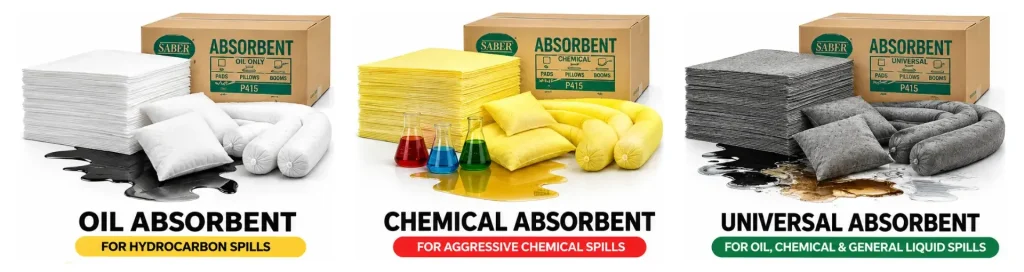
SABER offers several categories of absorbents, each designed for specific types of liquids:
- Oil Absorbents are designed for oil and hydrocarbon based liquids. Their water repellent properties make them suitable for managing oil spills on water surfaces.
- Chemical Absorbents are used for handling specific chemical substances, with selection based on the compatibility of the absorbent material with the spilled substance.
- Universal Absorbents are intended for a wide range of common liquids encountered during maintenance activities, in accordance with product specifications.
Therefore, if the spilled liquid is hydraulic oil, lubricating oil, or diesel fuel, an Oil Absorbent is the appropriate choice.
However, if the spill involves an unidentified chemical substance, do not immediately use an Oil Absorbent. Consult the Safety Data Sheet (SDS), identify the hazards, and verify the compatibility of the absorbent material first.
How to Use SABER Oil Absorbent Correctly
Spill response should follow the emergency response procedures established at the workplace facility.
- Step 1 — Identify the liquid and its hazards
Determine the type of liquid involved. Evaluate potential fire hazards, chemical exposure risks, and environmental risks. - Step 2 — Secure the area
Restrict access, wear appropriate personal protective equipment (PPE), and halt any activities that could increase risk. For flammable liquids, control ignition sources in accordance with safety protocols. - Step 3 — Stop the source of the leak (if safe to do so)
Repairs or the containment of the spill source must be performed only by authorized and trained personnel. - Step 4 — Contain the spread
Place oil-absorbent booms in appropriate locations to help contain the spread of the oil. - Step 5 — Absorb the liquid
Use oil-absorbent pads on surfaces, and oil absorbent pillows for areas where liquid has pooled or in confined spaces. - Step 6 — Collect used materials
Once the materials are saturated or absorption is complete, collect the absorbents while wearing appropriate PPE and place them into compatible containment vessels. - Step 7 — Manage waste in accordance with regulations
Materials that have absorbed oil, diesel, or other substances must be managed based on the characteristics of the contaminants and applicable waste disposal regulations.
Important: Large spills, highly flammable liquids, exposure to hazardous vapors, or incidents involving the contamination of water bodies should not be handled solely based on these general guidelines. Activate emergency response procedures and involve qualified personnel.
Can SABER Oil Absorbent Be Used Multiple Times?
The potential for reusing absorbent media depends on the material’s construction, its condition after use, the type of contaminants present, and company procedures.
Some sorbent technologies allow for oil recovery through specific methods. However, this does not mean that every type of SABER Oil Absorbent is safe to wring out or reuse.
For industrial applications, do not assume that a product can be reused without technical confirmation from the manufacturer. Contaminated absorbents must be treated as spill-cleanup waste and managed safely.
Purchase SABER Oil Absorbent at PT Panca Makmur Baru
Selecting industrial absorbent materials involves more than just finding a product that can soak up oil. Companies must also consider how well a product suits on site conditions, as well as factors like size, packaging, and specific procurement requirements.
PT Panca Makmur Baru is a provider of industrial tools and MRO (maintenance, repair, and operations) chemicals. As an official distributor of SABER products designed for use in workshops, factory maintenance, logistics facilities, mining operations, and the oil and gas sector the company offers solutions that can be tailored to the specific characteristics of a spill and the intended application.
Not sure whether to choose an oil absorbent pad, pillow, or boom?
Contact the team at PT Panca Makmur Baru for product information, specifications, availability, and a price quote tailored to your company’s needs.
Want to learn more or place an order now? Contact us at PT Panca Makmur Baru—the official distributor of SABER. Click the “Contact Us” button now!